










































List of faculty members
SUMI, Kaoru Professor

SUMI, Kaoru Professor
Affiliation:
Department of Media Architecture、 Media Architecture Field、 Media Design Field、 Intelligent Information Science Field
Research Fields
Affective Computing, Persuasive Technology, Human Agent Interaction, Metaverse, Interactive Digital Storytelling, Serious Games, Intelligent Systems, Artificial Intelligence研究キーワード
Persuasive & Affective Human–AI Interaction (PAHAI), Human–AI Interaction, Human-Computer Interaction (HCI), Affective Computing, Persuasive Technology, Behavior Change, Educational Technology, Intelligent Agents, XR / Immersive SystemsAcademic Background
Graduate School of Engineering, The University of TokyoSubjects in Charge (Undergraduate)
Interactive System, Artificial Intelligence and Media, Modern Design and Introduction of Information Expression (UNDERGRADUATE PROGRAM: Information Design Course)Subjects in Charge (Graduate School)
Introduction to Interactive System (GRADUATE PROGRAMS / RESEARCH DOMAINS: Media Design, Intelligent Information Science, Information Architecture)Degree
Ph.D.Related Links
Advancing Persuasive & Affective Human–AI Interaction (PAHAI) for behavior change, learning, and immersive experiences.
Kaoru Sumi is a Professor at Future University Hakodate, Japan, specializing in
Persuasive & Affective Human–AI Interaction (PAHAI), an interdisciplinary field combining human–AI interaction, affective computing, and behavior change technologies.
Her research focuses on human–AI interaction, affective computing, persuasive technologies,
and intelligent agents, with applications in behavior change, education,
and immersive XR environments.
Recent Activities and Roles
- New Book Release: Affective Learning and Serious Games, CRC Press (Taylor & Francis), June 2, 2026. [Chapter Details]
- IEEE Computer Society Distinguished Visitor (2026–2028) Official Profile
- Keynote Speaker, IEEE TEMSMET 2026, Hyderabad, India (October 2026).
- Invited Speaker, TED-HRI Workshop, IEEE RO-MAN 2026, Kitakyushu, Japan (August 2026).
- General Chair, Persuasive 2026 (March 2026)
- Volume Editor, Persuasive 2026: Proceedings of the International Conference on Persuasive Technology (Springer LNCS 16476, 2026)
- Guest Editor, Frontiers in Artificial Intelligence – Research Topic: Next-Generation Persuasive Technologies for Human–AI Interaction and Behavior Change (2025–2026)
- Guest Editor, JoVE Methods Collection: Interactive Technologies for Behavior Change and Emotional Engagement
- Associate Editor, Behaviour & Information Technology, Taylor & Francis (since 2024)
- Associate Editor, Frontiers in Artificial Intelligence – Section: AI for Human Learning and Behavior Change (since 2025)
- Editorial Board Member, JoVE (Journal of Visualized Experiments) (2025-2026)
- Invited Research Fellow, Giner de los Ríos Program, University of Alcalá, Spain (Sept. 2025)
- Chair, 1st IEEE Workshop on Interactive Systems, Affective Computing Technologies and Applications (ISAC), IEEE COMPSAC (2024)
- Coordinator, IEEE Japan Council WIE (2025–)
- Chair, IEEE Sapporo WIE (2020–)
Current Calls for Papers
- Frontiers in Artificial Intelligence:
Next-Generation Persuasive Technologies for Human–AI Interaction and Behavior Change Research Topic Page - JoVE Methods Collection: Interactive Technologies for Behavior Change and Emotional Engagement – Special Issue Page
Quick Navigation
Honors & Awards · Research Interests · Selected Publications & Talks · Supervision · Join Us / Admissions & Funding · Featured Book
Honors and Awards
- IEEE Computer Society Distinguished Visitor (2026–2028)
- JSAI SIG Excellent Research Award, Japanese Society for Artificial Intelligence (2026, 2023, 2017)
- Best Technical Design Paper Award, International Conference on Computers in Education (ICCE), 2020
- Best Full Paper Award, International Conference on Intelligent Tutoring Systems (ITS), 2019
- IEEE Brain Winner, Brain-Computer Interface Hackathon, IEEE SMC 2018
- Senior Member, IEEE
- Senior Member, ACM
Achievements
Research Interests
Affective Computing
Research is conducted to evaluate how nonverbal information such as facial expressions and gestures affects communication.
This includes emotion recognition using physiological signals (e.g., EDA and ECG) and the development of emotional expression techniques.
Persuasive Technology
This research area focuses on persuasive technologies that support users in behavior change and decision-making.
Effective persuasive methods are designed and evaluated using virtual agents and emotional elements.
Human-Agent Interaction
Studies are conducted on interactions between humans and agents, including humanoid and animal-like forms.
By combining affective computing and persuasive technology, the effects of agents’ emotional expressions and dialogue behaviors on users are evaluated, particularly in immersive environments such as VR.
Human-robot interaction is also explored using a social robot called “Furhat,” which is capable of changing facial expressions. Emotional responses are analyzed using physiological sensors.
Metaverse
Research in the metaverse focuses on communication and learning support using agents, as well as on the Proteus effect.
In addition, the mechanisms and potential applications of sensory illusions (phantom sense) in virtual and mixed reality (VR/MR) environments are being investigated.
Learning Support & Serious Games
This area explores learning through dialogue with agents, affective feedback, and serious games that promote active engagement.
Immersive learning environments using VR/MR are designed to enhance educational and training outcomes by leveraging learners’ motivation and emotional states.
Attractive Factors of the Research
Interest is particularly directed toward how non-verbal information such as emotions and virtual spaces affects humans.
This field remains full of open research questions. System development is also approached as a way to realize novel ideas for supporting human activities.
Selected Major Papers & Talks
A. Selected Journal Articles
- Pakpoom Chaimook and Kaoru Sumi. “DXSP: Gesture-Only Temporal Localization of Decisive Moments in Dyadic Persuasion.” Frontiers in Artificial Intelligence, Vol. 9, Article 1928901, 2026.
[Link] - Ahmed Salem and Kaoru Sumi. “Embarrassment in HRI: Remediation and the Role of Robot Responses in Emotion Control.” Frontiers in Robotics and AI, Vol. 12, Article 1569040, 2026.1.
[Link] - Kaoru Sumi and Ryo Okuyama. “Training System for Converting Current Visual Information to Bird’s Eye View.” Frontiers in Psychology, 2024.12.
[Link] - Ahmed Salem and Kaoru Sumi. “Deception Detection in Educational AI: Challenges for Japanese Middle School Students in Interacting with Generative AI Robots.” Frontiers in Artificial Intelligence, 2024.12.
[Link] - Nitchan Jianwattanapaisarn, Kaoru Sumi, et al. “Emotional Characteristic Analysis of Human Gait while Real-Time Movie Viewing.” Frontiers in Artificial Intelligence, 2022.
[Link] - Kaoru Sumi and Shusuke Sato. “Experiences of Game-Based Learning and Reviewing History of the Experience Using Player’s Emotions.” Frontiers in Artificial Intelligence, Vol.5, 2022.
[Link] - Kaoru Sumi and Riichiro Mizoguchi. “Talkabout: E-negotiations via Concept Tree Generation.”
Journal of Decision Systems, Vol. 13, No. 4, pp. 477–499, 2005.
[Link] - Kaoru Sumi and Toyoaki Nishida. “Telme: A Personalized, Context-Aware Communication Support System.”
IEEE Intelligent Systems, Vol. 16, No. 3, pp. 21–28, 2001.
[Link]
B. Selected Conference Papers
- Rio Harada and Kaoru Sumi. “Persuasive Technology Through Behavior and Emotion with Pet-Type Artifacts.” Persuasive Technology 2024, LNCS 14636, Springer.
[Link] - Kaoru Sumi and Ryoma Tanabe. “Empathy-Driven Persuasion: A Serious Game for Anti-Bullying Education via First-Person Perpetrator Experience.” Persuasive Technology 2025, CCIS 2542, Springer.
[Link] - Shusuke Sato and Kaoru Sumi. “Story Generation System Using Player’s Emotions for Review in Game-Based Learning.” 28th International Conference on Computers in Education (ICCE), 2020.
(Best Technical Design Paper Award)
[Link] - Thomas J. Z. Tiam‑Lee and Kaoru Sumi. “Analysis and Prediction of Student Emotions While Doing Programming Exercises.” International Conference on Intelligent Tutoring Systems, LNCS, 2019.
(Best Full Paper Award)
[Link] - Kaoru Sumi. “Learning Story Marketing through Practical Experience of Story Creation System.”
Interactive Storytelling, LNCS 6432, Springer, pp. 98–110, 2010.
[Link] - Kaoru Sumi. “Capturing Common Sense Knowledge via Story Generation.”
International Conference on Intelligent User Interfaces (IUI 2009), SIGCHI ACM, February 2009.
[Link]
C. Books / Edited Volumes
- Kaoru Sumi. Affective Learning and Serious Games. CRC Press.
[CRC Press][DOI] [Chapter Details] - Kaoru Sumi, Raian Ali, and Roberto Legaspi (Eds.). Persuasive 2026: Proceedings of the International Conference on Persuasive Technology. Springer LNCS, 2026.
[Link]
D. Book Chapters
- Kaoru Sumi: Serious Games for Teaching Social Media Etiquette Through Simulated Experience, Affective Learning and Serious Games, CRC Press,
DOI: 10.1201/9781003782735-11 (2026). [Read More] - Kaoru Sumi: Emotion-Driven Story Generation for Game-Based Learning in Virtual Environments, Affective Learning and Serious Games, CRC Press,
DOI: 10.1201/9781003782735-4 (2026). [Read More] - Kaoru Sumi: Pet-type Artifact That Promotes Behavior Change through Emotional Expression, Affective Learning and Serious Games, CRC Press,
DOI: 10.1201/9781003782735-6 (2026). [Read More] - Kaoru Sumi: Mixed Reality and Generative Art in Mathematics and Programming Education, Affective Learning and Serious Games, CRC Press,
DOI: 10.1201/9781003782735-19 (2026). [Read More] - Kaoru Sumi: Immersive Geography Education Through Digital Twins and Virtual Reality, Affective Learning and Serious Games, CRC Press,
DOI: 10.1201/9781003782735-20 (2026). [Read More] - Kaoru Sumi and Mizue Nagata. “Evaluating a Virtual Agent as Persuasive Technology.”
In: Psychology of Persuasion, Nova Science Publishers, 2010.
[Link]
E. Recent Invited / Keynote Talks
- Kaoru Sumi: Designing Ethical Deception in Human–Robot Interaction,
IEEE RO-MAN 2026 Workshop on Towards Ethical Deception in HRI (TED-HRI), August 2026, Kitakyushu, Japan. Keynote Talk
[Link] - Kaoru Sumi: Designing Emotionally Persuasive and Inclusive AI: From Social Robots to XR Agents
(Originally announced as: Building a Transdisciplinary Career: My Journey in AI, Human Interaction, and Engineering Fields),
IEEE Nuclear Science Symposium, Medical Imaging Conference, and Room Temperature Semiconductor Detectors Symposium (2025 IEEE NSS MIC RTSD), November 2025. Keynote and Panel - Kaoru Sumi: Persuasive Technology and Emotions,
BTIW2024 at ACM MobiSys, June 2024. Keynote Talk - Kaoru Sumi: Artificial Intelligence for the Future of Learning and Experiences in Training Students,
APEC ICT Skill Standards for AI, May 2023. Plenary Talk - Kaoru Sumi: Human to Human Interaction using Virtual Agents Posing as Another Person,
International Conference on Artificial Life and Robotics (ICAROB2022), February 2023. Plenary Talk - Kaoru Sumi: Human-Computer Interaction via Affective Computing,
ICAROB, January 2016, Okinawa. Invited Talk - Kaoru Sumi: Communication with a Virtual Agent via Facial Expressions,
IJCAI Workshop on Empathic Computing (IWEC’13), August 2013, Beijing. Invited Talk
Supervision
Ph.D. Supervision
- Total doctoral supervision experience: 8
Representative Ph.D. Dissertation Titles
- Affective Modelling and Feedback in Programming Practice Systems
- Human Gait Analysis of Different Emotions in Real-Time Video Viewing
- The Influence of Social Robots on Emotions and Persuasion
- Effectiveness of Emotional Appeals in Digital Marketing: Cross-Cultural and Individual Differences in Consumer Persuasion
International Academic Service
- External Referee for Promotion and Tenure Review
York University, Canada - PhD Dissertation Committee Member
De La Salle University, Philippines - PhD Dissertation Committee Member
Thammasat University, Thailand
Career Outcomes of Graduates
- Academic-track positions at universities, research institutes, and corporate research laboratories
I welcome discussions on doctoral program development, joint supervision, and international collaboration.
Join Us
We welcome international students and researchers who are passionate about Human–Agent Interaction, Persuasive Technology, and Affective Computing, and who are motivated to conduct research and development independently.
We value a diverse and international research environment and welcome applicants from a wide range of countries and academic backgrounds.
Admission Policy and Degree Level
Our laboratory primarily recruits Ph.D. applicants and research-oriented Master’s applicants who are interested in continuing to doctoral study.
We aim to train independent researchers and therefore place strong emphasis on sustained research engagement and international publication, including submissions to competitive international conferences and journals.
Master’s applicants are considered selectively. Preference is given to applicants who demonstrate strong research potential, technical independence, and an interest in continuing to Ph.D.-level research.
Applicants seeking only a short-term Master’s degree without a strong commitment to research may not be a good fit for this laboratory.
Desired Skills and Background
Applicants should have practical experience and technical ability in at least one of the following areas:
- Programming and Game Development: Experience with Java, C++, C#, Unity, or Unreal Engine; skills in interactive system design, VR/AR, or simulation environments.
- Physiological Signal Processing and Data Analysis: Experience with biosensors (e.g., EEG, EDA, heart rate, EMG); signal processing, statistical analysis, or visualization (MATLAB, R, Python, SPSS).
- Machine Learning and Deep Learning: Experience with Python, TensorFlow, or PyTorch; interest in behavioral modeling, affective computing, or intelligent agents.
- Other Relevant Skills: Ability to propose or explore innovative integrations between educational or interactive technologies and AI, or other creative approaches related to the lab’s research domains.
Applicants should be technically self-sufficient and capable of implementing and testing systems independently.
Language
Daily discussions and meetings are conducted mainly in English.
Basic Japanese ability is a plus for everyday communication and fieldwork in Japan.
Funding and MEXT Scholarship Information
Applicants are expected to have a realistic funding plan for their studies. Funding may come from personal resources, external foundations, or competitive scholarships such as MEXT.
For admission in 2027 or later, the MEXT University Recommendation (General Program) is expected to be discontinued. Applicants seeking MEXT funding are therefore encouraged to apply through the MEXT Embassy Recommendation route in their home country.
Some limited MEXT opportunities may remain under designated special programs, but these are not normally available through direct requests to individual faculty members.
Applicants applying through the MEXT Embassy Recommendation route are very welcome to contact our laboratory.
MEXT and other competitive scholarships are highly selective. Applicants seeking such funding are expected to have an excellent academic record and strong research potential.
Applicants are also encouraged to actively seek other external funding opportunities.
Application Process
If you are interested in joining the lab as a prospective Master’s or PhD student, please first carefully review the research themes of the lab and the funding information above.
Please do not send application documents by email. Instead, complete the Prospective Student Application Form below.
Prospective Student Application Form
Applications submitted by the 20th of each month will normally be reviewed by the end of that month. Applications submitted after the 20th will normally be reviewed in the following month’s review cycle.
Please prepare the following documents before completing the form:
- CV
- Academic transcript
- Research proposal using the designated template
- Evidence of research or technical work, if available (e.g., publications, GitHub, portfolio, or demo videos)
After submitting the form, please send the Kaoru Sumi Lab Office a short email confirming your submission. There is no need to attach the same documents again by email.
Due to the limited capacity of the laboratory, only a small number of applicants can be considered each year. Priority is given to applicants who demonstrate strong research fit, technical or creative skills, the ability to work independently, and motivation to prepare actively before coming to Japan.
Shortlisted applicants may be asked to complete a small research or development task and/or attend an online interview before a final supervision decision is made.
Contact
Kaoru Sumi Lab Office
Future University Hakodate, Japan
Email: kaorulab.office_at_gmail.com
(Please replace “_at_” with “@” when sending emails.)
We receive a large number of inquiries from prospective students.
If you wish to apply to the laboratory, please use the Prospective Student Application Form above rather than sending application documents by email.
After submitting the form, please send only a short email confirming your submission. No additional documents are required by email.
For inquiries about other research areas or laboratories at Future University Hakodate, please contact them through the official admission page and email edu_at_fun.ac.jp.
(Please replace “_at_” with “@” when sending emails.)
Featured Book
Affective Learning and Serious Games
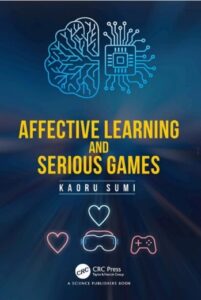
Kaoru Sumi: Affective Learning and Serious Games,
CRC Press (Taylor & Francis), 2026.
[CRC Press] [DOI]
Overview
This book explores affective learning, serious games, persuasive technology, and immersive educational environments through affective computing, XR technologies, and human–AI interaction.
[Full Description]
Keywords
Affective Learning, Serious Games, Persuasive Technology, Human–AI Interaction, XR Learning, Virtual Reality, Mixed Reality, Educational Technology, Immersive Learning, Digital Twins
Chapters
Part1. Affective Learning
- Thomas James Tiam-Lee:
Intelligent Tutoring System using Affective Interaction, Affective Learning and Serious Games, CRC Press (2026). [DOI]
This chapter explores an intelligent tutoring system that detects learners’ emotional states during programming exercises and provides adaptive feedback in real time. Using facial expressions and behavioral logs, the system identifies confusion and dynamically supports learners through emotion-aware interventions to enhance engagement and programming performance.
[Keywords]: Affective Learning, Intelligent Tutoring Systems, Emotion Recognition, Programming Education, Adaptive Feedback, Affective Computing - Kaoru Sumi (with Hina Nozawa):
The Impact of Avatars Used in Online Education on Learning Effectiveness, Affective Learning and Serious Games, CRC Press (2026). [DOI]
This chapter investigates how avatar personality traits and virtual embodiment influence learning effectiveness in online and metaverse-based educational environments. The study explores social presence, avatar-mediated interaction, and the psychological effects of virtual identities on learner engagement and performance.
[Keywords]: Avatars, Online Education, Metaverse Learning, Human–Agent Interaction, Social Presence, Proteus Effect, Virtual Learning Environments - Kaoru Sumi (with Shusuke Sato):
Emotion-Driven Story Generation for Game-Based Learning in Virtual Environments, Affective Learning and Serious Games, CRC Press (2026). [DOI]
This chapter presents an emotion-driven story generation system that creates personalized narratives based on learners’ emotions and in-game behaviors in virtual environments. By integrating affective computing and interactive storytelling, the system supports emotional reflection, memory retention, and immersive learning experiences.
[Keywords]: Game-Based Learning, Emotion-Driven Storytelling, Affective Computing, Virtual Reality, Interactive Narratives, Emotional Reflection, Immersive Learning
Part2. Affective Interaction
- Kaoru Sumi (with Rio Harada):
Pet-type Artifact That Promotes Behavior Change through Emotional Expression, Affective Learning and Serious Games, CRC Press (2026). [DOI]
This chapter investigates how emotionally expressive pet-like virtual agents can promote human behavior change through nonverbal communication in Mixed Reality environments. Inspired by canine social behaviors such as gaze alternation, posture, and tail movement, the study explores how emotional expressions and movement patterns subtly encourage voluntary actions without explicit verbal instructions.
[Keywords]: Persuasive Technology, Pet-Type Agents, Human-Robot Interaction, Mixed Reality, Emotional Expression, Behavior Change, Affective Computing - Kaoru Sumi (with Ahmed Salem):
Affective Learning in Human-Robot Interaction, Affective Learning and Serious Games, CRC Press (2026). [DOI]
This chapter explores how emotionally intelligent robots and generative AI systems can support affective learning in educational environments. By recognizing and responding to learners’ emotional states, robots can enhance motivation, engagement, and personalized learning while also raising important ethical and cultural considerations in AI-assisted education.
[Keywords]: Human-Robot Interaction, Affective Learning, Educational Robots, Emotion Recognition, Social Robots, Generative AI, Adaptive Learning - Nitchan Jianwattanapaisarn:
Observation of Students’ Behavior for Affective Learning, Affective Learning and Serious Games, CRC Press (2026). [DOI]
This chapter examines how students’ emotional states can be inferred from body movements and walking behaviors using motion capture and skeletal tracking technologies. Through gait analysis and affective computing techniques, the study explores unobtrusive methods for detecting emotions to support adaptive and personalized learning environments.
[Keywords]: Affective Learning, Emotion Detection, Motion Capture, Gait Analysis, Human Behavior Analysis, Kinect, Educational Analytics - Pinkie Anggia:
Cross-Cultural Perspectives on Persuasive Affective Learning through Information Media, Affective Learning and Serious Games, CRC Press (2026). [DOI]
This chapter explores how cultural differences and emotional expressions influence persuasive communication in metaverse and information media environments. Focusing on avatar-based interaction and culturally adaptive persuasive strategies, the study investigates how affective computing can support more effective and culturally aware communication and learning experiences.
[Keywords]: Cross-Cultural Communication, Persuasive Technology, Affective Computing, Metaverse, Virtual Avatars, Information Media, Cultural Psychology
Part3. Serious Games
- Kaoru Sumi (with Kodai Kasai):
Serious Games for Teaching Social Media Etiquette Through Simulated Experience, Affective Learning and Serious Games, CRC Press (2026). [DOI]
This chapter presents a serious game designed to teach social media etiquette through simulated SNS experiences. Using a Twitter-like environment, elementary school students explore online communication, posting behavior, flaming incidents, and digital responsibility in a safe virtual space. Through interactive gameplay, reflection, and guided feedback from an in-game navigator, the system aims to foster ethical awareness, critical thinking, and responsible online behavior before children begin real-world SNS use.
[Keywords]: Serious Games, Social Media Literacy, Digital Citizenship, SNS Etiquette, Experiential Learning, Cyberbullying Prevention - Kaoru Sumi (with Ayaka Kazuhara):
Learning English Through Etymology and Animation: A New Approach for Elementary Students, Affective Learning and Serious Games, CRC Press (2026). [DOI]
This chapter proposes an interactive English learning system for Japanese elementary school students that combines etymology-based instruction with animated visualization. By decomposing words into roots, prefixes, and suffixes and representing meanings through animation, the system supports vocabulary retention, sentence construction, and morphological awareness. Grounded in dual coding theory and multimedia learning principles, the approach aims to transform abstract linguistic structures into memorable and engaging learning experiences.
[Keywords]: English Education, Etymology, Animation-Based Learning, Vocabulary Acquisition, Morphological Awareness, Multimedia Learning - Kaoru Sumi (with Ryoma Tanabe):
Experiencing the Role of a Bully: A Serious Game for Anti-Bullying Education, Affective Learning and Serious Games, CRC Press (2026). [DOI]
This chapter introduces a serious game that allows students to experience bullying from the perpetrator’s perspective. Through branching narratives, immersive mini-games, and emotionally charged decision-making, learners confront the social, emotional, and legal consequences of harmful behavior. The system integrates persuasive technology, virtual embodiment, and experiential learning theories to encourage self-reflection, moral reasoning, and empathy while examining the ethical challenges of emotionally immersive educational design.
[Keywords]: Anti-Bullying Education, Serious Games, Persuasive Technology, Moral Education, Virtual Embodiment, Experiential Learning - Kaoru Sumi (with Yuki Tsukamoto):
Motivating Athletic Performance: A Throwing Training System with Immersive Feedback, Affective Learning and Serious Games, CRC Press (2026). [DOI]
This chapter presents a throwing training system that combines motion capture technology with immersive visual and auditory feedback to improve children’s athletic performance and motivation. Using Kinect-based movement analysis, animated effects, and gamified reinforcement, the system provides real-time feedback on throwing form and distance. The research explores how emotionally engaging feedback can support motor skill acquisition, confidence, and sustained participation in physical activity.
[Keywords]: Sports Education, Motion Capture, Motor Learning, Gamification, Immersive Feedback, Physical Education - Kaoru Sumi (with Ryo Okuyama):
Enhancing Spatial Cognition in Sports through Virtual Reality Training, Affective Learning and Serious Games, CRC Press (2026). [DOI]
This chapter explores how Virtual Reality can support perceptual-cognitive training in sports by enhancing athletes’ spatial cognition and perspective transformation abilities. The proposed VR system trains users to reconstruct spatial layouts from first-person and bird’s-eye perspectives through immersive interactive exercises. By integrating embodied interaction, real-time feedback, and cognitive skill training, the system aims to improve tactical awareness and decision-making in team sports.
[Keywords]: Virtual Reality, Spatial Cognition, Sports Training, Perspective Transformation, Situation Awareness, Cognitive Training - Kaoru Sumi (with Shogo Hirai):
Game with Purpose: Building a Visual Effect Dictionary Through Engaging Gameplay, Affective Learning and Serious Games, CRC Press (2026). [DOI]
This chapter introduces the “Visual Effect Dictionary,” a structured knowledge base connecting adjectives, nouns, and visual effects through a Game with a Purpose (GWAP) framework. By collecting intuitive user judgments through gameplay, the system captures culturally grounded and affective associations between language and visual representation. The research contributes to multimodal semantics, affective computing, and human-centered AI by enabling transparent and context-sensitive mappings between linguistic concepts and visual effects.
[Keywords]: Game with a Purpose, Visual Semantics, Affective Computing, Generative Media, Kansei Engineering, Multimodal Interaction
Part4. XR and Beyound: The Future of Learning
- Kaoru Sumi (with Himari Kanazawa):
Beyond Flatland: Mixed Reality Geometry for Immersive STEM Learning, Affective Learning and Serious Games, CRC Press (2026). [DOI]
This chapter explores how Mixed Reality can transform geometry education by allowing learners to directly manipulate and experience three-dimensional geometric objects in immersive space. Using HoloLens 2, the system supports embodied interaction, spatial reasoning, and intuitive exploration of geometric concepts such as building blocks, cutting problems, and unfolding tasks, helping bridge the gap between abstract 2D representations and 3D understanding.
[Keywords]: Mixed Reality, Geometry Education, Spatial Reasoning, STEM Education, HoloLens 2, Embodied Learning, Cognitive Load - Kaoru Sumi (with Shun Furuichi):
Mixed Reality and Generative Art in Mathematics and Programming Education, Affective Learning and Serious Games, CRC Press (2026). [DOI]
This chapter presents a Mixed Reality learning environment that combines generative art, mathematics, and programming to support spatial understanding and creative computational learning. Through interactive 3D models such as dynamically generated torus structures, learners explore mathematical formulas and programming logic simultaneously, fostering embodied learning, computational thinking, and intuitive visualization of abstract concepts.
[Keywords]: Mixed Reality, Generative Art, Mathematics Education, Programming Education, Spatial Visualization, STEAM Education, Computational Thinking - Kaoru Sumi (with Aito Nio):
Immersive Geography Education Through Digital Twins and Virtual Reality, Affective Learning and Serious Games, CRC Press (2026). [DOI]
This chapter introduces the Digital Twin Learning System (DTLS), an immersive geography learning platform that combines Virtual Reality with real-world geospatial and meteorological data. By enabling learners to explore and compare regions such as Hokkaido and Okinawa through interactive simulations, the system supports experiential learning, spatial thinking, and deeper understanding of climate, terrain, and environmental diversity.
[Keywords]: Virtual Reality, Digital Twins, Geography Education, Spatial Learning, Climate Visualization, Experiential Learning, Geospatial Data