










































教員一覧 List of faculty members
加藤 譲 准教授
KATO, Yuzuru Associate Professor

加藤 譲 准教授
KATO Yuzuru所属:
複雑系知能学科、 複雑系情報科学領域
研究分野
応用数学、数理工学(非線形科学、量子力学、制御工学)前職・前歴
東京工業大学担当科目(学部)
解析学I、II、数値解析、情報理論担当科目(大学院)
複雑系システム特論学位
博士(工学)
KATO, Yuzuru Associate Professor
Affiliation:
Department of Complex and Intelligent Systems
Research Fields
Applied mathematics and mathematical enginerring (nonlinear dynamics, quantum mechanics, control engineering)Academic Background
Tokyo Institute of TechnologySubjects in Charge (Undergraduate)
Analysis I & II, Numerical analysis, Information theoryDegree
Doctor of EngineeringRelated Links
研究内容
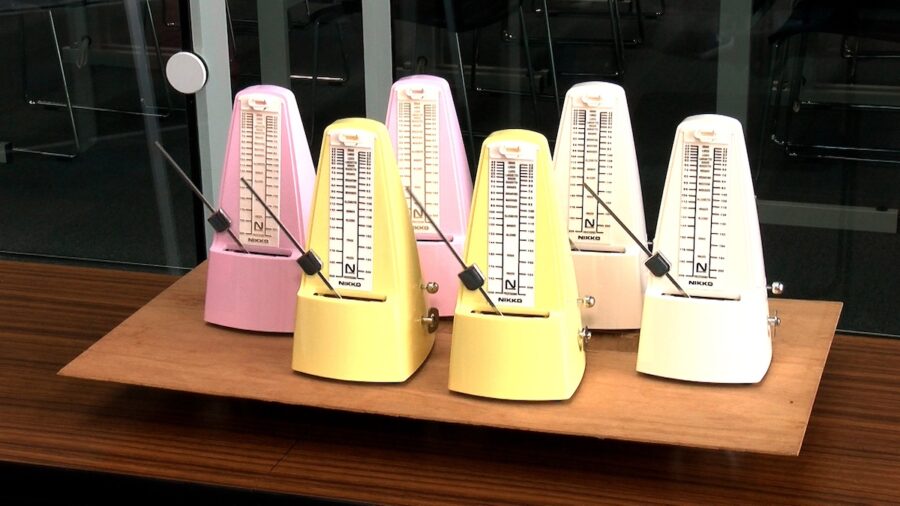
実世界における非線形現象を示す物理系を対象として、数理科学や数値計算を用いた解析を行っています。系をどのようにモデル化するか、系がどのような力学的振る舞いを示すか、系が出力するデータからどのような情報を引き出せるか、系に対してどのような制御器を設計できるかなどの問題に取り組んでいます。量子力学で記述されるミクロスケールの系から、古典力学で記述されるマクロスケールの系まで、幅広く扱っています。特に、原子集団、神経細胞、歩行者のステップ、化学反応など幅広い分野で見られる同期現象に興味関心があります。
研究の魅力
複雑な非線形現象の背後に潜む単純で普遍的な数理構造を解明することは、難しい数学のパズルを解くような楽しさがあります。また、このような数理構造に基づいて、実用的で汎用性のある工学の手法を設計することができます。
実績
半古典位相縮約理論を用いた量子同期現象の解析
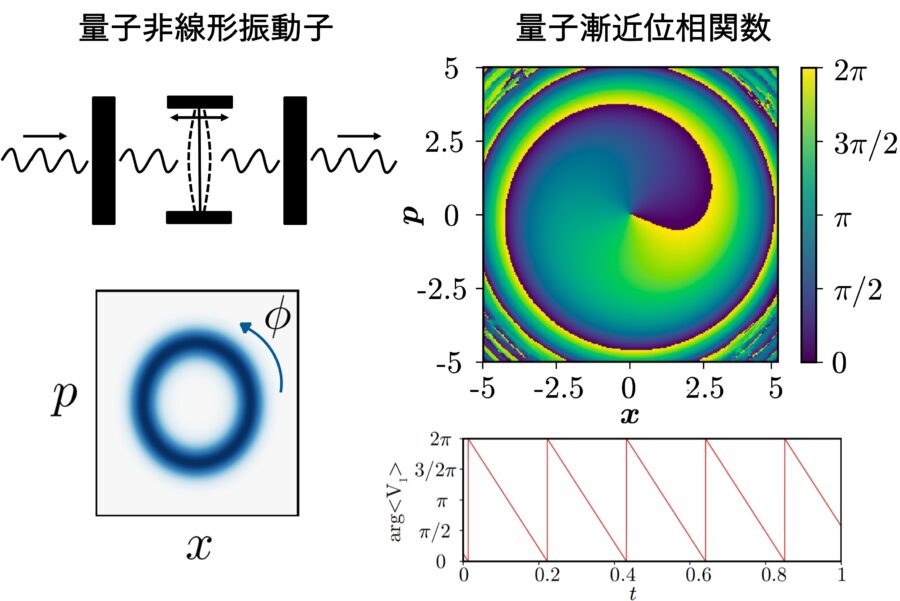
位相縮約理論は、多次元の非線形力学系の安定な周期軌道の運動方程式を、振動子の特性を集約した1次元の位相方程式に次元削減する理論です。位相縮約理論は、複雑な現実系の同期現象のメカニズムの解明やその制御手法を探索するためのガイドとなり、同期現象に関する基礎科学と技術応用の発展に大きく貢献してきました。本研究では、量子開放系の非線形振動現象に対して、量子系の半古典近似に基づく位相縮約理論を初めて定式化しました。半古典近似の下で、量子系の古典極限における決定論的なリミットサイクルに対する位相変数を定義して、その位相変数の1次元の確率微分方程式を系統的に導出して、位相縮約理論を定式化しました。例として、導出した位相方程式を用いて量子リミットサイクル振動子と調和外力との同期現象を解析し、系が適切なパラメータの範囲で調和外力に同期すること、及び、系の量子状態とパワースペクトルを近似的に再構築できることを数値計算によって明らかにしました。また、半古典位相縮約理論を用いて、半古典近似の下で量子同期現象の最適化理論を定式化しました。
非線形振動子と周期外力との同期現象における周期波形の大域的な最適化
同期現象の制御は、心臓ペースメーカーなどの同期現象の技術応用において重要です。位相縮約理論を用いることで、同期現象の制御に関する最適化理論を定式化でき、例えば、非線形振動子と周期入力との同期現象において、収束速度の局所的最大化などの最適化問題に対する周期入力の最適波形を解析的に導出できます。本研究では、解析解の導出が困難である大域的で複雑な最適化問題に対して、その数値最適解を求める手法を提案しました。より具体的には、周期入力のフーリエ級数展開に基づいて最適化問題を定式化し、その展開係数の数値最適解を非線形計画法により求めました。例として、所望の定常位相分布を得るための最適化と収束速度の大域的最大化の2つの最適化問題に対する数値最適解を導出し、その有効性を示しました。
限定アクセス下でのスピンネットワークの構造推定および初期状態生成
相互作用する複数の量子スピンからなるスピンネットワーク系は、量子情報処理のハードウェアの候補として盛んに研究されています。スピンネットワーク系を制御する際に系の安定性と信頼性を保つためには、事前に系の構造を知り初期状態を用意する必要があります。また、系の操作によるノイズの影響を低減するためには、操作するスピン数を最小限にする必要があります。本研究では、単一スピンのみの測定によるスピンネットワーク系のグラフ構造推定法と所望の初期状態生成法を提案しました。例として、5スピンの場合において、提案手法の有効性を数値計算により示しました。これらの提案手法を用いることで、安定性と信頼性の高いスピンネットワーク系の制御を行うことができます。
主な著作・論文
- Yuzuru Kato, Jinjie Zhu, Wataru Kurebayashi, Hiroya Nakao, Asymptotic phase and amplitude for classical and semiclassical stochastic oscillators via Koopman operator theory, Mathematics, Mathematics 9, 2188 (2021).
- Yuzuru Kato, Anatoly Zlotnik, Jr-Shin Li, Hiroya Nakao, Optimization of periodic input waveforms for global entrainment of weakly forced limit-cycle oscillators, Nonlinear Dynamics, 105, 2247‒2263 (2021).
- Yuzuru Kato, Hiroya Nakao, Quantum coherence resonance, New Journal of Physics, 23, 043018 1-10 (2021).
- Yuzuru Kato, Hiroya Nakao, Instantaneous phase synchronization of two decoupled quantum limit-cycle oscillators induced by conditional photon detection, Physical Review Research, 3, 013085 1-8 (2021).
- Yuzuru Kato, Hiroya Nakao, Enhancement of quantum synchronization via continuous measurement and feedback control, New Journal of Physics, 23, 013007 1-12 (2021).
- Yuzuru Kato, Hiroya Nakao, Semiclassical optimization of entrainment stability and phase coherence in weakly forced quantum limit-cycle oscillators, Physical Review E, 101, 012210 1-9 (2020).
- Yuzuru Kato, Naoki Yamamoto, Hiroya Nakao, Semiclassical phase reduction theory for quantum synchronization, Physical Review Research, 1, 033012 1-15 (2019).
- Yuzuru Kato, Naoki Yamamoto, Structure identification and state initialization of spin networks with limited access, New Journal of Physics, 16, 023024 1-19 (2014).
Research Contents
My research focuses on the analysis of real-world physical systems that exhibit nonlinear phenomena by using applied mathematics and numerical methods. My approach to these problems is based on concepts from physics as well as mathematical engineering, e.g., system modeling, dynamic analysis, signal processing, and controller design. I deal with both microscale phenomena described by quantum mechanics and macroscale phenomena described by classical mechanics. In particular, I’m interseterd in synchronization phenomena, which can be observed in various systems, such as atomic ensembles, spiking neurons, walking steps, and chemical reactions.
Attractive Factors of My Research
It is fun to elucidate the simple, universal mathematical structures underlying complex nonlinear phenomena, just like solving a difficult mathematical puzzle. Also, we can develop useful and versatile engineering methods based on these mathematical structures.
Achievements
Semiclassical phase reduction theory for quantum synchronization
We formulate the phase-reduction theory for quantum limit-cycle oscillators in the semiclassical regime. The phase-reduction theory has played a central role in analyzing the rhythmic dynamics of classical limit-cycle oscillators. This theory enables us to quantitatively approximate the dynamics of a nonlinear multi-dimensional limit-cycle oscillator by a simple one-dimensional phase equation, which has greatly facilitated systematic analysis of universal properties of limit-cycle oscillators, such as synchronization of oscillators with external periodic forcing, mutual synchronization between coupled oscillators, and the collective synchronization transition in a system of globally coupled phase oscillators. In this study, we generalize the conventional phase-reduction theory to quantum limit-cycle oscillators in the semiclassical regime where the quantum dynamics can be approximately described by a stochastic differential equation representing a system state in the phase space fluctuating along a deterministic classical trajectory due to small quantum noise. The developed semiclassical phase-reduction theory enables us to quantitatively approximate a quantum oscillator exhibiting stable limit-cycle oscillations by a simple one-dimensional phase equation, facilitating a systematic analysis of quantum synchronization in this regime. As a simple example, we analyze synchronization properties of a typical model of quantum limit-cycle oscillators subjected to a harmonic driving and approximately reconstruct the density matrix and power spectrum of the original quantum system from the reduced phase equation. Using the formulated semiclassical phase-reduction theory, we also consider optimal entrainment of a quantum nonlinear oscillator to a periodically modulated weak harmonic drive in the semiclassical regime.
Optimization of periodic input waveforms for global entrainment of weakly forced limit-cycle oscillators
We propose a general method for optimizing periodic input waveforms for global entrainment of weakly forced limit-cycle oscillators based on phase reduction and nonlinear programming. We derive averaged phase dynamics from the mathematical model of a limit-cycle oscillator driven by a weak periodic input and optimize the Fourier coefficients of the input waveform to maximize prescribed objective functions. In contrast to the optimization methods that rely on the calculus of variations, the proposed method can be applied to a wider class of optimization problems including global entrainment objectives. As an illustration, we consider two optimization problems, one for achieving fast global convergence of the oscillator to the entrained state and the other for realizing prescribed global phase distributions in a population of identical uncoupled noisy oscillators. We show that the proposed method can successfully yield optimal input waveforms to realize the desired states in both cases.
Structure identification and state initialization of spin networks with limited access
We provide two methods for structure identification and state initialization of spin networks accessible by only a single node. For reliable and consistent quantum information processing on quantum networks, the network structure must be fully known and a desired initial state must be accurately prepared on it. In this study, we provide two continuous measurement-based methods to achieve the above requirements for spin networks accessible by only a single node. First, we identify an unknown network graph structure based on continuous-time Bayesian updates. We numerically demonstrate that our graph estimator correctly identifies the true graph structure from five possible nominal graphs for three spin cases. Second, we propose a feedback control that deterministically drives an arbitrary mixed state to a spin-coherent state for network initialization. We numerically demonstrate that our feedback control can deterministically stabilize the spin-coherent states of the five spin networks.
Major Books and Papers
- Yuzuru Kato, Jinjie Zhu, Wataru Kurebayashi, Hiroya Nakao, Asymptotic phase and amplitude for classical and semiclassical stochastic oscillators via Koopman operator theory, Mathematics, Mathematics 9, 2188 (2021).
- Yuzuru Kato, Anatoly Zlotnik, Jr-Shin Li, Hiroya Nakao, Optimization of periodic input waveforms for global entrainment of weakly forced limit-cycle oscillators, Nonlinear Dynamics, 105, 2247‒2263 (2021).
- Yuzuru Kato, Hiroya Nakao, Quantum coherence resonance, New Journal of Physics, 23, 043018 1-10 (2021).
- Yuzuru Kato, Hiroya Nakao, Instantaneous phase synchronization of two decoupled quantum limit-cycle oscillators induced by conditional photon detection, Physical Review Research, 3, 013085 1-8 (2021).
- Yuzuru Kato, Hiroya Nakao, Enhancement of quantum synchronization via continuous measurement and feedback control, New Journal of Physics, 23, 013007 1-12 (2021).
- Yuzuru Kato, Hiroya Nakao, Semiclassical optimization of entrainment stability and phase coherence in weakly forced quantum limit-cycle oscillators, Physical Review E, 101, 012210 1-9 (2020).
- Yuzuru Kato, Naoki Yamamoto, Hiroya Nakao, Semiclassical phase reduction theory for quantum synchronization, Physical Review Research, 1, 033012 1-15 (2019).
- Yuzuru Kato, Naoki Yamamoto, Structure identification and state initialization of spin networks with limited access, New Journal of Physics, 16, 023024 1-19 (2014).
この教員に関係する研究シーズ
複雑系研究入門:数学で複雑な現象を操る
NEWS
「加藤 譲」に関連する最新のニュース